

On being a rural optometrist
Phil Anderton is a semi-retired optometrist who researched and taught optometry and vision science at the University of New South Wales between 1978 and 2005. He has now “retired” to live near a small town in Northern NSW where he runs a Primary Care Optometry clinic one day per week. He is the Rural Optometry Group representative on the Council of the National Rural Health Alliance.
“In a previous life I was a Senior Lecturer in Optometry and Vision Science at the University of NSW in Sydney NSW. One of my duties in 1995 was to create a course to underpin the expansion of the scope of practice in optometry to include topical therapeutic drugs – eye drops. Over a period of 12 months I enlisted the help of American therapeutic optometrists and their ophthalmologist colleagues, and they became intimately involved in the Course.
When the course was first advertised, many of the optometrists who first enrolled were based in rural Australia. As I observed their performance and behavior during the course, it became clear that many of them were already quite skilled at the details of relevant differential diagnoses and drug prescription for the various eye diseases. When I questioned them, they told me that “therapeutics” and the management of disease had been a major part of their daily workload for years – it was “par for course” in rural optometry.
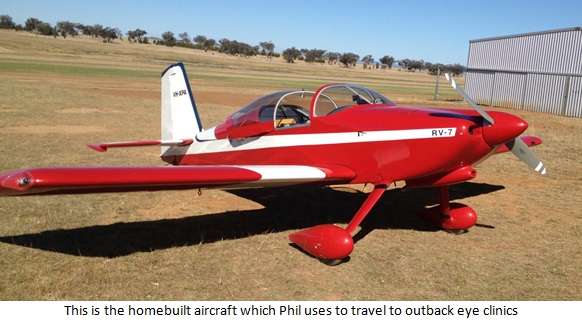
I retired from Academia in 2005, and decided to live in a small town in Northern NSW to pursue and interest in gliding and aviation. As soon as the local doctors discovered that I was an optometrist, they BEGGED me to run a part-time clinical practice, so their patients did not have to travel 50km and back to the nearest big centre to see an optometrist or ophthalmologist. So I ended up finally practicing what I had preached as an Academic ten years earlier.
The two key features of rural optometry practice which I find attractive are probably valid for all the other health professions:
- Rural lifestyle and way of life – Rural people are friendly, laid back, usually positive, sometimes funny and always very appreciative of good service. If you love horses, bushwalking, agriculture or aviation, the best way to pursue these interests is to move out of the big cities.
- A High Degree of Clinical satisfaction – in the cities there is little call for optometrists to manage disease as city GPs generally refer directly to local ophthalmologists where they can usually be seen promptly. In rural Australia there are few resident specialists of any kind (for example, four ophthalmologists in my area servicing 150,000 people), and their non-urgent waiting lists can be measured in months. The local GPs often rely on their local optometrists for intermediate support if a non-urgent eye/vision problem is suspected. The optometrists have good working relationships with the local GPs, community nurses, hospital emergency department and nearest ophthalmologists, and they have the ophthalmic equipment to facilitate examination and diagnosis. Like GPs, they are more liberally distributed around the regions than are specialists. In this way, true sight-threatening emergencies are detected and referred promptly, and other conditions treated locally by the optometrist and/or GP. The whole process involves positive teamwork, interdisciplinary reliance, and sometimes some fascinating case material. I love it!
This year I worked with a new graduate in Dubbo to survey rural optometrists to find out what motivated their choice of location. The two themes outlined above were consistently identified as prime motivators.
If you are city-based and thinking of the rural option, please go ahead and try it, but do so in a way which allows you an exit strategy if things don’t work out. For example, you could work as an employee for a year or two and rent accommodation, while ensuring that you and your employer agree to a “probationary” period in your contract. That way, if things don’t work out, no harm done. In any case, you will have a unique challenging and satisfying clinical experience that you will value for the rest of your life.
Relevant Links
National Rural Health Alliance – www.ruralhealth.org.au
Optometrists Association Australia Rural Optometry Group – www.optometrists.asn.au/advocacy/advocacy-platform/rural-optometry.aspx”