
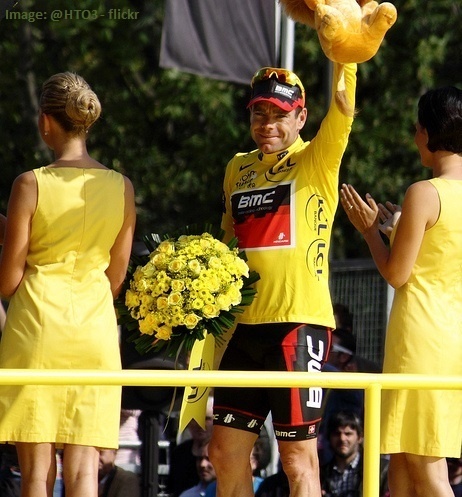
A lesson from Cadel Evans on not giving up!!
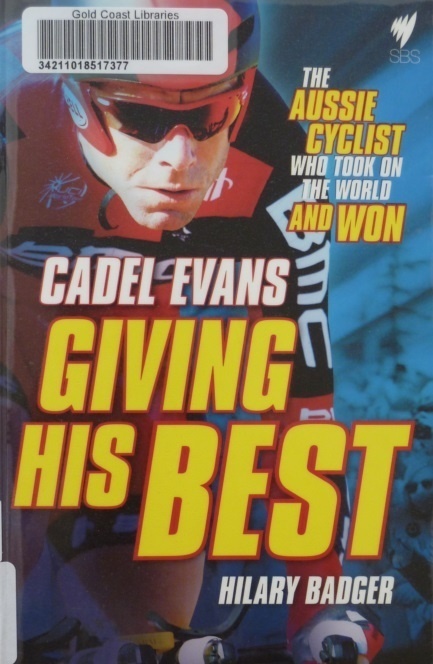
Not so long ago I read a biography about Australian Cyclist Cadel Evans. You might know him as the guy who won the Tour De France in 2011. While I was reading his biography, I couldn’t help but think about how many opportunities Cadel had to quit before staying in cycling to win the world’s most prestigious road race in 2011.
Cadel started his cycling career in the sport of mountain biking, but seeing the telecast of the Tour de France in the early 1990s, had a respect for road cyclists too. As a 19 year old Cadel competed in the 1996 Atlanta Olympic Games. He expected big things from himself, and was disappointed to place 9th in the mountain bike race.
He won his first World Cup mountain bike race in Wellington, New Zealand, at the age of 20, and was signed with the prestigious Volvo-Cannondale team. Riding for this team, he won the World Cup series, but Cadel never went on to win the mountain bike one-day World Championship title.
In 1998, Cadel was seriously thinking about becoming an elite road cyclist, and a win in the Tour of Tasmania was a sign that he had what it took to make it as a road cyclist. Wanting to represent Australia in mountain biking at the 2000 Sydney Olympics, Cadel became the hot favourite to win the cross-country event, and, after battling for the lead, dropped back to seventh position at the end of the race.
By 2001, he was a road cyclist with the team Saeco-Cannondale, and had a win over American cyclist Lance Armstrong in a race in Lausanne, Switzerland. After more great results road racing in 2001, he switched to become a full time road cyclist.
It is during his road cycling career that Cadel faced some of his most turbulent times:
- In 2002, Cadel joined the Mapei team, which was full of star riders, and the team’s lead rider failed a routine drug test
- When Mapai announced it was pulling out of its cycling sponsorships, Cadel had to find a new team in 2003, and he moved to German team Deutsche Telekom
- In 2003, Cadel broke his collarbone during a race in the Netherlands in April, and again in a race in Germany at the end of May – he required surgery, which meant he wouldn’t be able to compete in the Tour de France
- In 2004, Cadel wasn’t selected as a Tour de France rider in his team, so didn’t compete
- Cadel rode for a new team Davitamon-Lotto in 2005, and had an accident in training, injuring his hip, knee, shoulder and collarbone as he had been riding downhill at over 50km/h
- Following his 2005 injury, Evans finished a disappointing 15th in the Tour de Swisse, and went on to a good result to place 8th overall in his first Tour de France – however, some riders who finished ahead of Cadel later admitted to doping at various stages of their careers, and the race winner Lance Armstrong was in 2012 stripped of all his Tour titles after not defending the doping charges against him
- In 2006 Cadel suffered from headaches which were so bad that he would lose vision in one eye, making it difficult to ride in road races
- Before the 2006 Tour de France there was a series drug raids, and many of the top riders were caught up in it and couldn’t race – race winner Floyd Landis was also stripped of the title, so Cadel finished 4th overall
- More doping scandals plagues the 2007 Tour de France, and without much support from his team members, Evans managed to finish second overall
- In 2008, Cadel’s team Silence-Lotto recruited stronger mountain climbers to support him in his quest to win the Tour de France, but when it came to crunch time in Stage 17, his support rider wasn’t riding as well as hoped – Cadel finished second again overall
- 13 days before the 2008 Olympic games in Beijing, Cadel slipped over and injured his knee, and although he did compete, he came 15th in the road race and 5th in the time trial
- In 2009, Silence-Lotto team mates Bernhard Kohl and Thomas Dekker failed a drug tests, and Cadel finished in 30th place, with his team announcing that he wouldn’t be the sole leader of the team in the future
- By 2009, Cadel had become known as the “Nearly Man” in the world of cycling as he had come close to some big wins – some people thought he was unlucky and others thought he didn’t have what it took to win a major race
- On 27th September 2009, Cadel silenced the critics and won the men’s World Championship road race in Mendrisio, Switzerland
- In 2010 Evans moved to the BMC team, and had a big win in the Giro d’Italia early in the season, but his Tour de France performance was affected by a hairline fracture in his left elbow due to a crash
- In 2011, the BMC team riders provided excellent support for Evans in the Tour de France, and, although he lost time due to a mechanical problem in one of the later stages of the race, he rode a brilliant Stage 20 time trial to win the 2011 Tour de France
I don’t know about you, but I think there is so much that we can take away from this. It wasn’t just about performing well in the 2011 Tour de France, it was about everything Evans had to go through on the way to his big win. If you had to go through obstacles such as competing against (drug) cheats, having (drug) cheats on your team, moving on from team politics, changing teams so many times and other setbacks such as injuries would you have stayed on the course?
It’s worth thinking about that. What obstacles are you willing to overcome to reach your goals? Everyone who has achieved great things has had obstacles along the way. What is it that you want badly enough that you will keep working at it no matter what?
So where did it all start for Cadel?
Cadel was born in the Northern Territory in 1977, and given a name that means “battle” in Welsh. When he was 4 years old, his father helped him take the training wheels off his bike, as at that young age, Cadel felt that the training wheels were slowing him down. He moved to Victoria with his mother when he was in grade 7 at school, and lived in an outer suburb of Melbourne which had plenty of open green spaces, hills and trails – perfect for a bike-obsessed kid.
Click here for more inspirational articles on My Health Career.