

When the world seems upside-down – mindfulness in audiology practice by Jessica Blakely
Audiology is an area not many people are familiar with, and even if you are somewhat familiar with it, you may think Audiologists only deal with hearing issues and hearing aids. However another very important part of the ear is the inner ear balance system called the vestibular system. The vestibular system is pretty incredible. It constantly monitors your head position giving feedback to your muscles to keep you upright and the eyes to keep a steady image of the world in vision while you are moving. If the balance system is under stress or damaged, you may experience symptoms such as vertigo or dizziness.
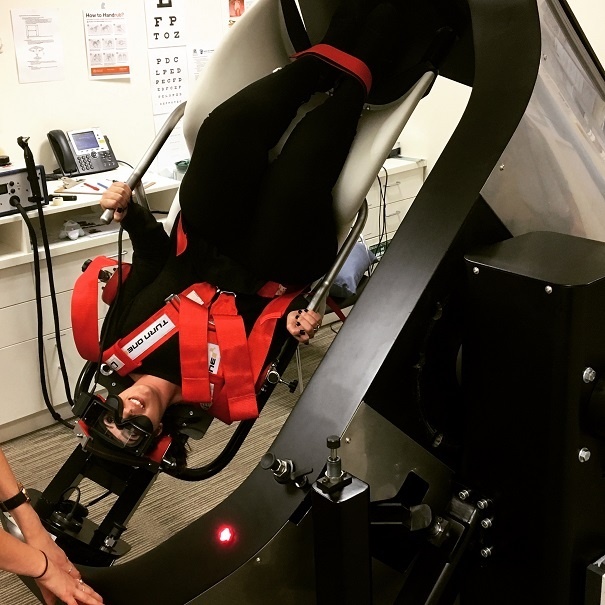
Audiologists working in the vestibular field are fortunate as the research in this area and the diagnostic tools are rapidly advancing. These advancements allow us to precisely identify the parts of the inner ear that are working (or not working) the way they should be. At the University of Melbourne we have also recently acquired a new tool that can help us specifically identify and treat the most common cause of vertigo, Benign Paroxysmal Positional Vertigo or BPPV. The TRV chair from Interacoustics, named after its inventor, allows us to diagnosis and treat patients with more subtle symptoms or variants of this condition that may have been missed at the bedside.
Being able to comprehensively assess inner ear function assists with an accurate diagnosis of what is causing a patient’s symptoms. However, it is important to remember that a patient is more than just their symptoms and diagnostic results. Understanding the psychological impact of a patient’s symptoms is paramount in their overall recovery and this is an area that is continuing to develop.
A powerful tool that has been gaining a lot of attention in all health fields is mindfulness. Mindfulness is a state of active, open attention on the present. When you are mindful, you observe physical and emotional events without judging them as positive or negative. It is a skill that anyone can learn. There are several studies evaluating the effectiveness of mindfulness-based interventions as a treatment of both physical and psychological symptoms (Shapiro et al., 2006).
For our dizzy patients, being able to observe the present moment without judgement teaches them that different experiences come and go over time. This allows them to recognise the transitory nature of their symptoms. It also teaches them that thoughts are just thoughts rather than a reflection of reality, and so it is not always necessary to react to a particular thought (Lang., 2013).
 Mindfulness also teaches us to continually shift our attention to something in the present moment, for example, breathing. It is normal that after some time the attention will shift onto thoughts or something in the environment. However when this happens mindfulness teaches us to simply notice the shift in attention without judgment and then to refocus. This tool helps patients to improve their focus and allows them to actively choose where they put their attention. This can be a pretty powerful choice faced with symptoms of vertigo or dizziness.
In addition to managing the physical symptoms of vertigo and dizziness, mindfulness can be used to conquer the psychological impact of these symptoms. Many people experiencing symptoms of vertigo or dizziness will also experience some form of anxiety. In a survey of 21,781 people with vestibular vertigo, as many as 46% also reported having generalised anxiety (Bigelow et al., 2016). Mindfulness-based interventions have been shown to be effective at reducing anxiety levels as demonstrated by a number of studies (Arch et al., 2013; Hofmann et al., 2010; Vøllestad et al., 2011; Vøllestad, Sivertsen, & Nielsen 2011). For both symptoms of anxiety and vertigo, mindfulness teaches us to be willing to embrace emotional or physical distress rather than try to avoid the experience all together.
All these mindfulness-based strategies discussed can take away the helplessness of not knowing what to do when symptoms of vertigo and dizziness start. These strategies can also help to stop patients from living in fear about when their symptoms may occur next because they know that they are equipped with tools to manage if they do reoccur. Mindfulness also teaches patients that no matter how bad they feel in the moment, it will pass.
While mindfulness is not routinely taught in our vestibular clinics, our hope is that with continuing research validating its effectiveness, we will be able to develop specialised clinics aimed at giving patients the tools to effectively manage their dizziness.
References:
Arch, J. J., Ayers, C. R., Baker, A., Almklov, E., Dean, D. J., & Craske, M.G. (2013). Randomized clinical trial of adapted mindfulness-based stress reduction verses group cognitive behavioural therapy for heterogeneous anxiety disorders. Behaviour Research and Therapy, 51 (4-5), 185-196.
Bigelow, R. T., Semenov, Y. R., du Lac, S., Hoffman, H. J., & Agrawal, Y. (2016). Vestibular vertigo and comorbid cognitive and psychiatric impairment: the 2008 National Health Interview Survey. Journal of Neurosurgery Psychiatry, 87(4): 367-372.
Hofmann, S. G., Sawyer, A. T., Witt, A. A., & Oh, D. (2010). The effects of mindfulness-based therapy on anxiety and depression: A meta-analytic review. Journal of Consulting and Clinical Psychology, 78(2), 169-183.
Lang, A. J. (2013). What mindfulness brings to psychotherapy for anxiety and depression. Depression and Anxiety, 30(5): 409-412.
Shapiro, S. L., Carlson, L. E., Astin, J. A., & Freedman, B. (2006). Mechanisms of mindfulness. Journal of Clinical Psychology, 62(3), 1-14.
Vøllestad, J., Nielsen, M. B., & Nielsen, G. H. (2012). Mindfulness- and acceptance-based interventions for anxiety disorders: A systematic review and meta-analysis. British Journal of Clinical Psychology, 51(3), 239-260.
Vøllestad, J., Sivertsen, B., & Nielsen, G. H. (2011). Mindfulness-based stress reduction for patients with anxiety disorders: evaluation in a randomised controlled trial. Behaviour Research and Therapy, 49(4), 281-288.
Jessica Blakely graduated with a Masters of Clinical Audiology from The University of Melbourne in 2012. She also holds a Bachelor of Science from Monash University and completed her honours year based at the Alfred Hospital in Melbourne. Jessica works as a clinician in the Melbourne Audiology and Speech Pathology Clinic at the University of Melbourne and also in private practice.
Images: supplied
Discover more about mindfulness: