
Optometrists’ opinions on new Medicare item numbers
It’s been exactly one month since new item numbers for optometrists were launched in the Medicare Benefits Schedule. We decided to ask some optometrists what they thought about the item numbers.
Just to recap before we dive in……
10944 – Removal of an embedded corneal foreign body that is sub-epithelial or intra-epithelial, and the removal of rust rings from the cornea ($72.15)
10945 – A professional attendance of less than 15 minutes by a participating optometrist that requires the provision of clinical support to a patient who is participating in a video conferencing consultation with a specialist practising ophthalmology ($33.45)
10946 – A professional attendance of at least 15 minutes by a participating optometrist that requires the provision of clinical support to a patient who is participating in a video conferencing consultation with a specialist practising ophthalmology ($66.80)
10947 – A professional attendance of less than 15 minutes by a participating optometrist that requires the provision of clinical support to a patient (at the time of attendance is located at a residential aged care facility) who is participating in a video conferencing consultation with a specialist practising ophthalmology ($33.45)
10948 – A professional attendance of at least 15 minutes by a participating optometrist that requires the provision of clinical support to a patient (at the time of attendance is located at a residential aged care facility) who is participating in a video conferencing consultation with a specialist practising ophthalmology ($66.80)
A rural perspective – Phil Andert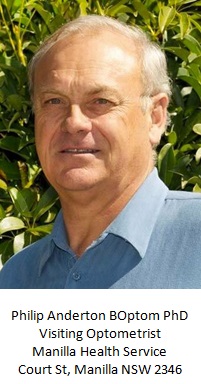 on
on
We asked rural optometrist Phil Anderton what he thought of the new item numbers. Phil said “In many rural towns the local optometrist is the only health professional with the optimal equipment used to remove foreign bodies (a slit-lamp biomicroscope). In these locations, optometrists and GPs work together to ensure prompt and appropriate care for the many farmers, mechanics and others who experience painful embedded corneal foreign bodies. The advent of this new item, and the telehealth item, will provide the right mix of care from local optometrists and GP, and also a remote ophthalmologist online if needed”
Opinions from Young Optometrists
 We asked Young Optometrists to shed some light on what they thought about not only the new item numbers, but also whether they had used any of them yet, and also for their thoughts on what other item numbers they would like to see introduced. And wow, did we see some great responses!!
a) Which item numbers do you think are most relevant to your practice?
- “haven’t looked into it, but seems really good, previously used 10916 instead”
- “we have updated our system to have 10944 for FB”
- “we won’t be using telehealth much, so the FB one will be more relevant, mainly because metropolitan location means that an ophthalmologist is down the road”
- “only the 10944 is relevant”
- “used the FB removal one but not sure if it was appropriate because didn’t use a needle, used tweezers, but it was definitely embedded”
- “FB most relevant to me”
- “not actually aware of the ophthal telehealth one yet, but think that corneal FB one is fairly relevant. FBs are not unusual to see so I think it’s a good inclusion”
- “FB removal definitely relevant, the other ones not so much because of ease of access to an ophthalmologist, however this may be possible if the right set up is available when I go on rural trips”
- “FB 10944 is relevant”
- “I think the FB removal one is the most relevant. We do a fair few of them, though I haven’t had the chance to bill it yet. The other telehealth doesn’t apply to my practice”
- “I do know the FB removal one, which will come in handy. I work in a group practice with ophthals so my item number usage might be a little different. I do mostly 10905s and 10916, 10918”
- “most relevant FB one”
- “10944”
- “910/911/914/913/918/907/915/921 (order of importance – the first is most important) But with the new Medicare numbers, the most relevant would be the 10944, because won’t be qualified to use the tele health ones! And even so, won’t get to use 944 often enough in a suburban practice because most people goes straight to GP or hospital. GP then refers to ophthal or hospital because these are very accessible where the practice location is”
- “The foreign body removal item number would be most relevant since I practice in a regional area which has a significant proportion of the population who work in mining and other industrial work as well as agriculture where there is an increased risk of corneal foreign body occurrences. It is also more difficult for patients to access ophthalmology services both privately and publicly compared to the capital cities.”
- “I probably use 10911, 10914, 10918 and 10940 the most”
b) Have you used the new item numbers already, or do you intend to use them soon?
- “haven’t used, but would if any FB people came in”
- “telehealth is useless to me in my location”
- “I will use the number if a corneal FB walks in”
- “Haven’t used the new numbers yet. Would use it given the chance when it happens (if ever)”
- “have not used soon but would definitely intend to use 10944 when given the chance”
- “have not used it but intend to”
- “don’t think anyone has used them in our practice already but sure the FB one will be used”
- “no use for telehealth since I have the luxury of having ophthals nearby”
- “have used the FB one only so far”
- “definitely intend to use FB one in the future”
- “none yet, definitely intend to use the FB one”
- “haven’t really looked into the telehealth ones yet, haven’t used any of the new item numbers yet, probably will use the FB removal one for now”
- “intend to use FB removal soon in near future”
- “I personally have not used the foreign body removal item number yet and do not have the required equipment to remove embedded corneal foreign bodies and rust rings, so probably will not use it soon. Although, I have seen several patients with corneal foreign bodies and if I had the equipment they would definitely have benefited from this item number. However I think that it is a great step forward to recognise that optometrists have the expertise to remove embedded corneal foreign bodies, and should be appropriately renumerated for this procedure. Since many young optometrists have graduated with therapeutic qualifications and training in foreign body removal, I think this item number is particularly relevant to them.”
- New FB Medicare – I plan to use it. My store have ordered needs, chlorsig minims and a sharps bin for each room.”
c) Are there other item numbers that YOs think are relevant and should be introduced?
- “Introduce another VF number for headaches because 10940 can’t be claimed for headache related VF test, Estermann needs to be included in VF as a separate item number too for glaucoma or monocular. RGP fits are too long, every 3 years needs to be reduced to every 2 years maximum. Also, OCT for glaucoma, diabetes should be on Medicare
- “maybe a red eye or therapeutic one. An additional one which can be billed for OCT where further analysis is needed to avoid patients having to pay for these extras. Most practices take $50 or $60 for an OCT, but this would be hard to outline and regulate.”
- “to be honest, haven’t thought about item numbers much, so can’t shed light on what should be included”
- “nothing I can think of”
- “don’t think about Medicare item numbers much, but patients always ask why retinal photography is not covered, also that dilation for new patients should be given extra, for example patients with flashes who have never seen you before and are not eligible because this would only be a 10916. Because I feel for flashes a lot of the time I have to squeeze them in and feel I should be paid more, eg not the same amount as an eyelash epilation.”
- “fundus photos or OCT for reduced VAs, new patient with emergency symptoms
- “for better data collection and understanding of what types of appointments are being done, perhaps more specific coding for red eye follow ups, or therapeutics related eye exams, or eyelash epilation instead of a generic 10918. There are separate ones for diabetes 10915 which are to track diabetic eye exams, why not different ones to address the expanding scope of practice? Not sure whether this will work against us, but it makes sense to be more transparent with the government to have a better understanding of how we contribute to health care. CL item numbers are quite specific, why not our other services?”
- “contact lens Rx’s last 12 months, why is it only possible to claim every 3 years?”
- “Advanced imaging. (Optos, OCT, topography) where it is indicated in diagnosis or treatment of list of specific conditions (ie diabetic retinopathy, AMD, macular edema)”
- “digital retinal imaging e.g. once every 3 yrs or when eligible for an initial”
- “GP or specialist to optom referral, retinal imaging, any FB including conjunctival”
- “a number for OCT in conjunction with 10940/10941 should be created for glaucoma suspects/pxs”
- “GP and other health professional referrals, retinal imaging and OCT, vision training”
- “In that case telehealth would help if we develop a relationship with the ophthal and they’re expecting calls from us. That’s usually bed a booking of its own so am it wouldn’t help too much in my situation. FB removal though, it’s only for cornea not conjunctiva, but could be helpful if/when people know to come in for it”
- “The only thing I can think of is more private health related (if an item number could be assigned to imaging that’d be great, but that’s not Medicare)”
- “I think an item number that contributes towards retinal photography would be relevant as this is now really the standard of care. It could be at least introduced for those patients who are diabetic or with identified retinal pathology such as AMD or glaucoma. Perhaps also an item number that allows for a comprehensive consultation within the 1 or 3 year cycle when it is a new patient referred by a GP, e.g. for headaches, who requires a full test but the patient cannot receive a full rebate since they have already claimed a comprehensive consultation within the Medicare cycle. I know that OA was surveying optometrists about this within the last few years.”
- “I think there should be a 10900 just for children under 12 to be used annually for progressing myopes”
- “There should be an item number for referrals from GPs, ophthalmologists or the referral item number from optometrists should include referrals from GPs, ophthals. There should also be an item number for glaucoma co-management i.e. doing gonioscopy, pachymetry, Goldman tonometry, VF. Instead of non-specific item numbers for comprehensive examinations, it should be explicit whether the patient was dilated or un-dilated. Hence, there should be separate item number for an eye examination that is dilated and another one for un-dilated, with the dilated giving more $ back.
Please also note that there are more specifics for each item number than have been summarized here. For example, the corneal foreign body removal item number relates to foreign bodies that are removed with a hypodermic needle, foreign body gouge or similar surgical instrument with magnification provided by a slit lamp biomicroscope or similar device. Please refer to the Medicare Benefits Schedule for all the details.
Thanks so much to everyone for your responses!! It’s great to see so many ideas out there.
Amanda Griffiths
Optometrist and Founder MHC :-)
More articles on My Health Career: