
Possible eye emergency – flashes of light and floaters in the vision
The take-home message: if you have a recent onset of flashes of light (e.g. like lightning bolts) or floaters (e.g. that looks like a series of small red or dark coloured spots, a cobweb, thread of cotton, a mosquito or fly) in your vision, contact and consult your eye care professional as soon as you can.
As an optometrist, I have people present with a recent onset of either flashes of light or floaters in their vision, and sometimes both at the same time. I would estimate that of the cases I see, around 0.5% to 1% of the time it is a serious, sight-threatening emergency, where the person needs to be examined by an ophthalmologist and may require surgery or laser within 24 to 48 hours. Happily though, most times they are going through a normal process in the eyes, which does not result in any damage to the eyes.
At the practices where I work, the staff on the reception desk are trained to squeeze people in to our appointment schedule even if we are fully booked to have their eyes checked ASAP when they call to tell us they are seeing flashes of light or floaters in their vision. If they call at a time when we may not have an optometrist in the practice, they are told to seek an examination elsewhere, and, if it is over the weekend, present to a hospital.
Now that I have written an introduction to an article giving people information I wish they’d receive when consulting “Dr Google”, I will go into the more common causes of flashes of light and floaters in the vision….
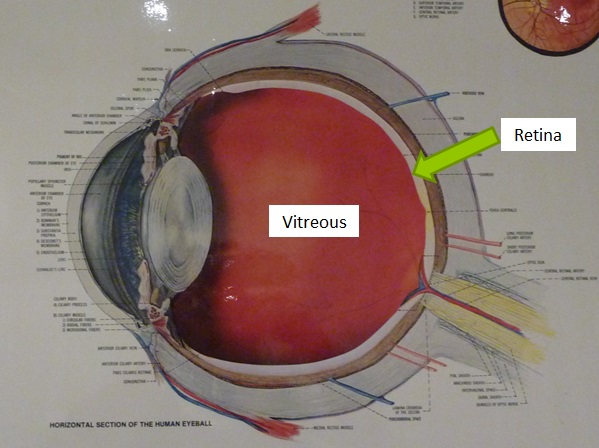
- RETINAL DETACHMENT – it’s an emergency: There is the chance that the retina, the inside lining of the eye has come away from the layer that it should be attached to. This is called a retinal detachment, and it is similar to having wallpaper peel off a wall. Obviously, the aim of the game is to get your wallpaper (retina) repaired as soon as you can, as, if the amount of retina that peels away is extensive (especially if it includes the macula), the result can be permanent visual impairment (a lot of websites will say blindness, but you although you might have no useful vision you would still be able to tell the difference between light and dark) in that eye. Surgical options for a retinal detachment are outlined here. Surgery is generally carried out within 24 to 48 hours of your consultation with the surgeon. Symptoms often start with flashes of light being present in your vision in the lead up to the detachment. If there is a floater or spot in your vision, it might be red or a dark colour (and there can be one, a few or many of these). The vision might be blurred. If you leave it and a significant portion of your retina detaches, you will see a dark curtain come over your vision. In my professional life, I have had a patient present with a retinal detachment who just said that they had noticed flashes of light for a week, and had a single floater. Others had lots of flashes and floaters.
- RETINAL TEAR – it’s serious but the treatment is generally straightforward: Generally a retinal detachment follows on from a retinal tear that has been left untreated. So if there is a retinal tear, the aim of the game is to get the tear treated so it doesn’t progress to the detachment stage. You could think of a retinal tear like a tear in wallpaper on your wall, but in eyes the wallpaper is attached to the vitreous jelly which acts with gravity to make the tear bigger and bigger until the retina detaches. Depending on the location and severity of the tear, your optometrist would send you to an ophthalmologist straight away, or within a few days. In most cases, the tear is treated with a laser in the ophthalmologist’s rooms, and you don’t need to go to an operating theatre. I have had people who have noticed a few flashes of light with or without a floater in their vision who have had a retinal tear. If a retinal tear has nicked a blood vessel, people might red, pink, or dark-coloured spots floating in their vision.
- POSTERIOR VITREOUS DETACHMENT – you’re going to be just fine: The vitreous is the jelly-like substance that fills the back section of the eye. It has a “skin”, or membrane which attaches it to the retina. Often times between 50 and 70 years of age, the vitreous jelly membrane will peel away from the retina, and cause no damage to the retina. This is called a posterior vitreous detachment. Often people notice flashes of light and a new spot or spots floating in their vision. Once the floater is present, it will always physically be there. In most cases, the brain learns to ignore the floater so that over time you see it less and less.
You’ve probably noticed that the symptoms of posterior vitreous detachments, retinal tears, and the early stages of a retinal detachment can be quite similar. One more than one occasion I have examined eyes of patients who come in with symptoms of what I theorize to be a straightforward posterior vitreous detachment, but on examination I find a retinal tear. So really, it is in your best interest to see your eye care professional at the onset of any flashes of light or floaters in your vision.
For more information
UK retinal specialist Prof Paulo E. Stanga also has an informative page about posterior vitreous detachments, retinal tears and holes, which includes a great image of a tear in the retina leading to a detachment.
Professor Nathan Efron, who is a well-known researcher in the field of optometry, wrote a series of blogs which follow his journey of retinal tears in each eye, which were lasered to avoid retinal detachments. It is worth noting that laser is usually performed in an ophthalmologists rooms, not an operating theatre as Prof Efron required:
Only once you have consulted your eye care professional and have had it confirmed that yes, you have a posterior vitreous detachment should you indulge in this amusing video featuring Stewie from Family Guy. It’s called “Ode to Squiggly thing.”
Click here to find an optometrist or click here to find an ophthalmologist in Australia (if you did have a retinal detachment or tear, it would be a vitreo-retinal surgeon who would do the repair, but ANY ophthalmologist would be able to identify whether you have a serious problem such as a detachment or tear).
Amanda Griffiths – optometrist
1 replies to “Possible eye emergency – flashes of light and floaters in the vision”
Thank you for highlighting such an important topic! I’ve experienced flashes and floaters recently, and it’s reassuring to know what might be causing them and when to seek help. Your information is really valuable in understanding these symptoms better.